Buying Guides
What Importers Should Check Before Ordering
A pre-order checklist for importers of quartz composite kitchen sinks: specification completeness, sample evaluation, QC terms, container planning and the commercial points that cause disputes later.
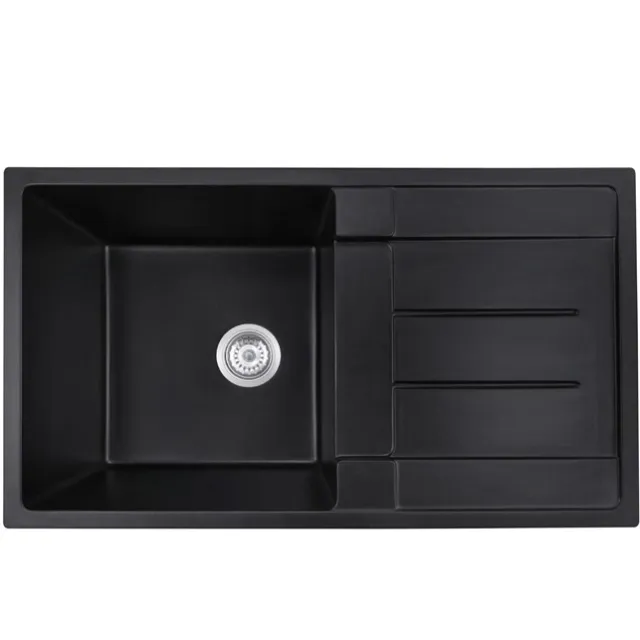
Most sourcing disputes do not start with a bad product. They start with a quote that was never specific enough to be enforceable. The sink arrives, it is broadly what was discussed, and it is still not what the buyer needed — a 3 mm difference in bowl depth, a rim that does not suit the local fabricator, a colour that is two shades off the showroom sample.
This checklist covers what to confirm before you place a first order for quartz composite kitchen sinks, in the order that protects you most.
1. Confirm who you are actually buying from
Before specifications, confirm the counterparty. Ask for the legal entity name, business registration details, the address that appears on shipping documents, and the contact who will handle claims after the container ships.
This is not about suspicion, it is about paperwork. The name on the invoice needs to match the name on the certificate of origin and the name that will answer when a customer complains eight months later.
Also confirm, in writing, what the supplier is responsible for and what they are not: production, consolidation, documentation, or only trading. A clear scope prevents the classic argument where each side assumes the other arranged the inspection.
2. Insist on a specification sheet with tolerances
A dimension without a tolerance is an opinion. Request one sheet per model covering:
- External length × width × depth, with stated tolerance
- Bowl dimensions per bowl, plus bowl depth
- Corner radius, both internal bowl and cutout
- Drain hole diameter, overflow type and position
- Mounting method and rim profile
- Material composition description and resin system
- Finish: colour code, gloss or matte, surface treatment
- Net weight and gross carton weight
- Carton dimensions, pallet quantity, units per container
Then compare the sheet across models. If two models share a specification sheet word for word, the sheet was not written for those models.
3. Evaluate the sample against a protocol, not an impression
Open the carton in daylight and work through a fixed list, so that batch two is judged the same way as batch one:
- Colour. Compare against the approved colour code under daylight. Check the bowl interior and the rim, not just the top face.
- Particle consistency. Look for streaks, resin-rich patches or uneven fleck density.
- Bowl geometry. Measure depth and width at more than one point. A bowl that is 3 mm shallower at one end will hold water.
- Edges and drain hole. Run a finger along the rim and the drain edge. Chips and hazing show up here first.
- Flatness. Place the sink on a flat surface and check for rock. An untrue rim will not seal.
- Template match. If the model is undermount, confirm the supplied cutout template matches the sink you received.
- Accessories. Fit the colander, board or grid if included. They should sit level, without rocking.
Record what you find with photographs and measurements. That record becomes the reference for the production run, and it is the document you rely on if the second shipment differs.
4. Agree quality control terms before production
QC language in a purchase order is worth more than any assurance in an email. Agree at least:
- Inspection stage. During production, before packing, or both.
- Sampling basis. The AQL level you are working to, written into the order.
- Who inspects. Supplier's in-house check, your own agent, or a third-party inspection company. If third party, agree who pays and how much notice is required.
- Evidence. Photographs and video of the packed cartons, the pallet configuration and the container loading, sent before the container leaves.
- Defect definition. What counts as a defect, what counts as acceptable variation, and what triggers a replacement.
Without a defect definition, "quality problem" becomes a negotiation rather than a claim.
5. Fix the commercial terms in writing
The points below cause more disputes than product quality:
- Price basis. EXW, FOB, CIF or delivered. Name the port. A price without a named Incoterm is not a price.
- MOQ per model and per colour. Many suppliers quote MOQ per model, then apply a separate minimum per colour. Confirm both, because colour minimums are what usually break a mixed order.
- Price validity. Composite pricing moves with resin and mineral costs. Agree how long a quotation holds and how a re-quote is triggered.
- Payment structure. Deposit and balance percentages, and against what documents the balance is released.
- Lead time. Confirm it as a number of working days from deposit and artwork approval, with the approval step named. Lead time that starts "after confirmation" with no defined confirmation date is not a commitment.
- Tooling or mould charges. If a new size or colour needs a mould, confirm whether the charge is one-off, amortised, and who owns the mould.
6. Plan the container before you plan the reorder
Ask for carton dimensions and pallet configuration for every model in the order, then calculate container fill yourself rather than accepting a round number. Composite sinks are heavy, and the limiting factor is often weight rather than volume.
Two checks worth doing at this stage:
- Gross weight per carton and total gross weight against the container limit.
- Stack height and whether the cartons are designed to be double-stacked for the sea leg.
Also agree the packing standard for edges and corners. Composite chips in transit when corner protection is thin, and transit damage is usually excluded from the supplier's quality claim.
7. Confirm what documentation your market needs
Which declarations and markings are required depends on your destination market and your own obligations as importer. Those requirements are yours to confirm with your compliance advisor — do not rely on a supplier's summary of them.
What you can reasonably ask a supplier for is a clear statement of what they can and cannot provide, in writing. If a document is offered, ask to see it before the order, and check that the scope it covers actually matches your product and your market. A certificate that covers a different model or a different scope is worse than no certificate, because it creates a false sense of coverage.
8. Agree the after-sales structure in advance
Decide before the order how a claim will be handled:
- Who is the contact for claims, and in what language.
- What evidence is required (photographs, carton labels, batch reference).
- The claim window, counted from container arrival.
- Whether remedy is replacement, credit or spare parts, and who bears freight.
- Whether spare drains, overflow kits or accessories can be added to a later order.
Most claims are small: a handful of units with a chipped edge or a mis-matched colour. A pre-agreed remedy turns those into an email. Without one, they turn into a discount negotiation on the next order.
9. Red flags worth walking away from
- A specification sheet with no tolerances, or one that is identical across unrelated models.
- Photographs that are clearly renders, or that show a different colour to the sample.
- No defined MOQ per colour, discovered only at order confirmation.
- Reluctance to name the port or the Incoterm.
- No defect definition and no inspection stage offered.
- Claims of certification that cannot be produced on request.
To put these checks into practice, the catalogue includes the 7750, the 460 and the 7249; the full product range is available for review.
Next step
KAIRUISHENG supplies quartz composite kitchen sinks to importers, distributors and wholesalers from Guangdong, China. If you are preparing a first order, send your target specifications, colour direction and destination port to Cyndi@kairuisheng.com or message +86 13434825666 on WhatsApp, and we will respond with a model-by-model specification sheet, carton data and commercial terms for your review.