Buying Guides
Quartz Composite vs Granite Composite Kitchen Sinks: What B2B Buyers Should Compare
A procurement-focused comparison of quartz composite and granite composite kitchen sinks: filler mineral, surface behaviour, weight, colour consistency and the specs to request before quoting.
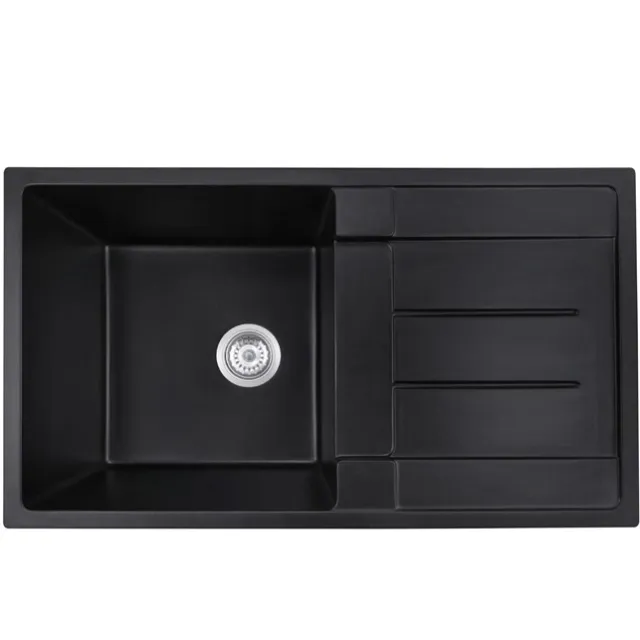
Both product families sit on the same shelf in most catalogues, both are marketed as "stone sinks", and both are quoted at a similar price band. That is exactly why importers get caught out: the two materials behave differently in production, in transit and in the customer's kitchen, and the difference is rarely written on a spec sheet.
This guide is written for buyers building or refreshing a wholesale range. It compares the two materials on the points that actually affect landed cost, complaint rate and shelf appeal, and it lists the specifications worth requesting before you commit to a purchase order.
A note on naming first: "granite composite" and "quartz composite" are marketing labels, not standardised material grades. Different suppliers use the same words for different filler mixes, and the same mix can be labelled differently. Treat the descriptions below as typical starting points, and confirm the actual filler and resin on a written specification sheet rather than assuming them from the name.
What "composite" actually means
A composite kitchen sink is a moulded body made of mineral filler bound in resin. In most commercial production the filler is the majority of the mix and the resin is the binder; pigments, and sometimes a gel-coat or surface treatment, sit on top.
The two families differ in the filler:
- Granite composite typically uses crushed granite, or a granite-quartz blend, as the mineral content.
- Quartz composite uses quartz crystals (silica) as the mineral content, usually with a finer and more controlled particle distribution.
Because the filler is the bulk of the material, it drives hardness, weight, colour behaviour and how the surface responds to wear.
Hardness and surface behaviour
On the Mohs scale, quartz (about 7) is harder than the feldspar that makes up much of granite (around 6). Some buyers and suppliers use this to position quartz composite as the more scratch-resistant of the two — but real-world scratch resistance also depends on resin quality and filler distribution, so judge it on a sample rather than on the mineral number alone.
In practical procurement terms, that translates into three things to test on a sample rather than accept on a datasheet:
- Bowl abrasion. Rub the base and the lower bowl wall with a scouring pad. Fine filler and good resin distribution resist dulling; coarse filler shows a lighter patch.
- Edge quality. Look at the rim and the drain hole edge. Sharp, well-finished edges indicate a controlled mould cycle; chipped or hazy edges indicate the opposite.
- Colour depth after abrasion. A dark sink that turns grey where it is rubbed has pigment only at the surface, not through the body.
Neither material is scratch-proof, and no supplier should tell you otherwise. What a buyer is really buying is how long the surface keeps its appearance under normal kitchen use.
Colour and particle consistency
This is where the two families diverge most visibly, and where most range planning decisions are actually made.
Granite composite is normally sold with a speckled look: contrasting mineral flecks on a base colour. It hides water spots and light scratches well, and it photographs forgivingly. The trade-off is that batch-to-batch fleck density can drift, which matters if you are building a colour family across several sizes.
Quartz composite is often associated with a finer, more uniform particle structure, which can allow tighter colour matching across a range and makes solid or near-solid colours practical. Whether that consistency holds for a given supplier's production is worth verifying across batches, not assuming from the label.
When you evaluate samples, do it in daylight, not under office lighting. Compare at least two production batches of the same colour, and compare the sink against the carton label and the colour code you were quoted.
Weight, installation and cabinet requirements
Composite sinks are substantially heavier than stainless steel alternatives. That is not a defect, but it changes three parts of the supply chain:
- Cabinet reinforcement. Base cabinets need to carry the sink plus a full bowl of water. Undermount installation concentrates that load on the countertop cutout, so substrate and fixing method matter.
- Countertop fabrication. Composite sinks are commonly installed undermount, which means the fabricator needs a cutout template, the corner radius and the wall thickness. Supply these with the product, not on request.
- Freight and handling. Higher unit weight reduces the number of pieces per pallet and per container, which changes your landed cost calculation. Always calculate cost per container, not cost per piece.
If your market relies on drop-in replacement rather than new kitchen fabrication, confirm the rim profile and the overflow position early. A perfectly good sink with the wrong rim profile becomes a return.
Heat, chemicals and everyday care
Both materials are resin-bound. The resin is the part that reacts to heat and to aggressive chemistry, so the care guidance is broadly similar for both families:
- Use a trivet or mat for hot pans rather than placing cookware directly on the surface.
- Clean with a pH-neutral detergent. Strong solvents, undiluted bleach and aggressive descalers can dull the surface.
- Avoid abrasive powders on matte finishes.
As an importer, put this guidance on the retail packaging and in the product page copy. Most surface complaints are care complaints, and they arrive after the container has been paid for.
The specification sheet to request before quoting
Do not quote a range on a photograph. Ask for the following, per model, in writing:
Item | What to confirm |
|---|---|
External dimensions | Length × width × depth, with stated tolerance |
Bowl dimensions | Per bowl, plus bowl depth |
Material composition | Filler type and resin system description |
Finish | Colour code, gloss or matte, surface treatment |
Drain and overflow | Drain hole diameter, overflow type and position |
Mounting | Undermount, drop-in or dual, plus rim profile |
Corner radius | Internal bowl radius and cutout radius |
Weight | Net unit weight and gross carton weight |
Carton | Dimensions, pallet quantity, container loading quantity |
Commercial | MOQ per model and per colour, price basis, lead time, payment terms |
Any supplier who cannot supply dimensions with tolerances is not quoting a product, they are quoting an intention.
How to decide between the two
Work backwards from your market rather than forwards from the material:
- If your buyers want one consistent colour across a size family, quartz composite is usually the easier range to hold together.
- If your buyers want a speckled stone look that hides marks, granite composite does that job well.
- If your channel is replacement-driven, check rim profiles and standard cutout sizes before anything else.
- If your channel is project or developer supply, confirm the installation method and template package first, because those projects fail on fitment, not on colour.
In practice, many distributors carry both: granite composite for volume and speckled colourways, quartz composite for solid colours and premium positioning. The two lines cross-sell rather than compete.
If you want to see finished quartz composite models rather than compare materials on paper, our catalogue includes the 8650 single bowl, the 7848 and the 7848X variant. The full range is listed on the products page.
Next step
KAIRUISHENG supplies quartz composite kitchen sinks to importers, distributors and wholesalers from Guangdong, China. If you are building a range and want dimensions, finish options and commercial terms per model, send your target sizes and colour direction to Cyndi@kairuisheng.com or message +86 13434825666 on WhatsApp, and we will quote against your specification rather than against a photo.